Physical Address
304 North Cardinal St.
Dorchester Center, MA 02124
Physical Address
304 North Cardinal St.
Dorchester Center, MA 02124

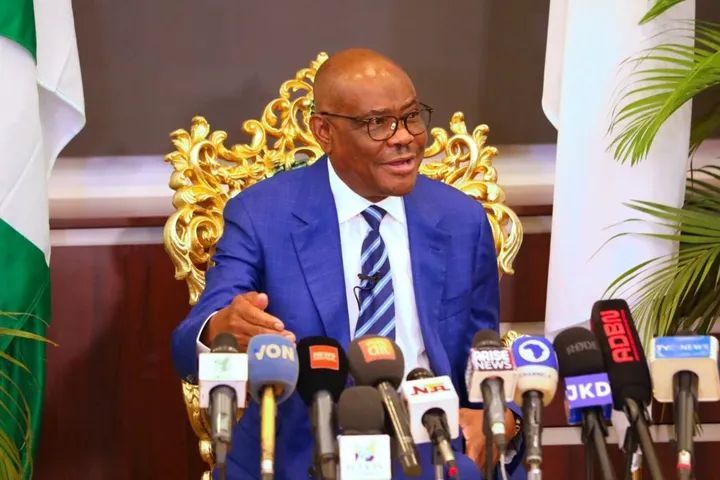
The Minister of the Federal Capital Territory (FCT), Nyesom Wike, has defended the Rainbow Coalition, insisting that the political arrangement is designed to mobilise support for President Bola Ahmed Tinubu’s re-election in 2027 rather than create divisions within the ruling All Progressives Congress (APC). Wike dismissed concerns expressed by some APC governors that the coalition could undermine the party’s structure and weaken the electoral chances of its candidates in the forthcoming general elections. Speaking during a media parley in Abuja on Tuesday, October 13, 2026, the former Rivers State governor maintained that the initiative was intended to bring together supporters of Tinubu from different political backgrounds to pursue a common objective.
Wike explained that the coalition should not be mistaken for a parallel APC structure or an attempt to challenge the party’s leadership. According to him, the arrangement provides a platform through which politicians and supporters who may not belong to the APC can work alongside members of the ruling party to support Tinubu’s second-term ambition. He argued that the president’s re-election was the coalition’s primary concern, adding that people should be allowed to contribute to that objective regardless of their political affiliations. In his view, the fact that individuals belong to different parties does not necessarily prevent them from agreeing on a common candidate for the presidential election.
The minister’s comments come against the backdrop of disagreements between him and several APC governors over the coalition’s activities ahead of the 2027 elections. The governors, operating under the Progressive Governors’ Forum, have expressed concerns about political arrangements that could weaken the APC or undermine the chances of its candidates at various levels. Their position reflects the party’s interest in maintaining a coordinated political structure as it prepares for another general election. Wike, however, has rejected the suggestion that the Rainbow Coalition poses such a threat, insisting that the concerns surrounding the initiative are misplaced.
At the heart of the disagreement is the question of whether support for Tinubu’s presidential ambition should automatically translate into support for APC candidates in governorship, senatorial, House of Representatives and state assembly elections. Wike has consistently maintained that these are separate political contests and that his commitment to the president does not prevent other political parties from fielding candidates for other offices. He has specifically stated that he never promised that the Peoples Democratic Party (PDP) would refrain from contesting elections at the state and legislative levels. This position has become a major point of contention between the minister and APC stakeholders who want party members and political allies to support the ruling party’s candidates across the board.
To support his argument, Wike has referred to the outcome of the 2023 general elections, when voters in several states supported candidates from different political parties in presidential and legislative contests. He cited Imo, Abia, Enugu and Ebonyi states as examples of places where the voting pattern demonstrated that citizens could choose one party’s candidate for the presidency and another party’s candidate for the Senate or other legislative positions. According to the minister, these voting patterns show that political allegiances do not always follow a single direction across every election on the ballot. He believes the same principle could apply in 2027, with voters supporting Tinubu for president while making independent choices in governorship and legislative contests.
Wike has also drawn comparisons between the Rainbow Coalition and the role played by the G5 governors during the 2023 presidential election. The G5, a group of governors associated with the PDP, opposed the party’s presidential candidate, Atiku Abubakar, amid disagreements over the party’s leadership and power-sharing arrangements. Wike and other members of the group subsequently supported Tinubu’s presidential bid. The minister has questioned why similar concerns about political disruption were not raised when the G5 operated during the previous election cycle. By making this comparison, he is arguing that political cooperation across party lines is not entirely new in Nigeria and should not automatically be interpreted as an attempt to destabilise an established political organisation.
However, the APC governors’ concerns extend beyond the presidential election. Their position is that a coalition involving politicians from different parties could complicate the ruling party’s efforts to coordinate its candidates and campaign machinery across the states. Where members of such an arrangement support Tinubu at the presidential level but back candidates from opposition parties in other contests, the APC could face competing political interests during the same election cycle. This concern is particularly relevant in states where governorship and legislative elections are closely connected to local political alliances. Wike, on the other hand, maintains that state-level political disputes should be resolved within their respective states rather than being presented as a reason to oppose support for Tinubu’s re-election.
The controversy has also drawn attention to Wike’s unusual position in Nigeria’s political landscape. Although he remains associated with the PDP, he serves in Tinubu’s APC-led federal administration and has openly pledged to support the president’s bid for a second term. This arrangement has generated debate about party loyalty, political cooperation and the boundaries between personal political choices and collective party interests. Wike has defended his position by arguing that support for a presidential candidate does not require an individual or political group to abandon every other political interest. His stance, however, has not resolved the disagreement, as some APC leaders continue to insist that political actors should clearly identify with the party whose candidates they intend to support.
For Tinubu, the emergence of the Rainbow Coalition presents another dimension to the political mobilisation expected ahead of the 2027 presidential election. Support from politicians outside the APC could potentially broaden the president’s political reach, particularly in areas where the party faces challenges or where voters have historically divided their support among different parties. Nevertheless, the coalition’s practical impact will depend on its organisational capacity, the commitment of its members and its ability to translate political declarations into support at polling units. The disagreements surrounding its structure also show that broader political alliances can create tensions when their objectives overlap with the electoral ambitions of established parties and their candidates.
As the 2027 elections approach, Wike’s defence of the Rainbow Coalition is likely to remain part of the wider debate over political alliances and electoral strategy in Nigeria. The minister insists that the initiative is focused on securing another term for Tinubu, while critics within the APC remain concerned about its implications for the party’s candidates and internal organisation. The disagreement ultimately centres on whether cross-party cooperation for a presidential candidate can coexist with separate political contests at state and legislative levels. For now, Wike maintains that there is no contradiction in supporting Tinubu while allowing other parties to compete for other offices, leaving the APC leadership and its governors to determine how they intend to manage the political differences before the next general election.