Physical Address
304 North Cardinal St.
Dorchester Center, MA 02124
Physical Address
304 North Cardinal St.
Dorchester Center, MA 02124

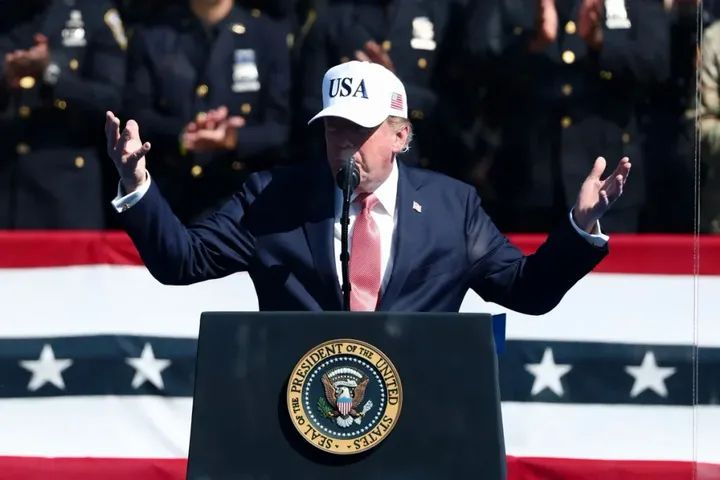
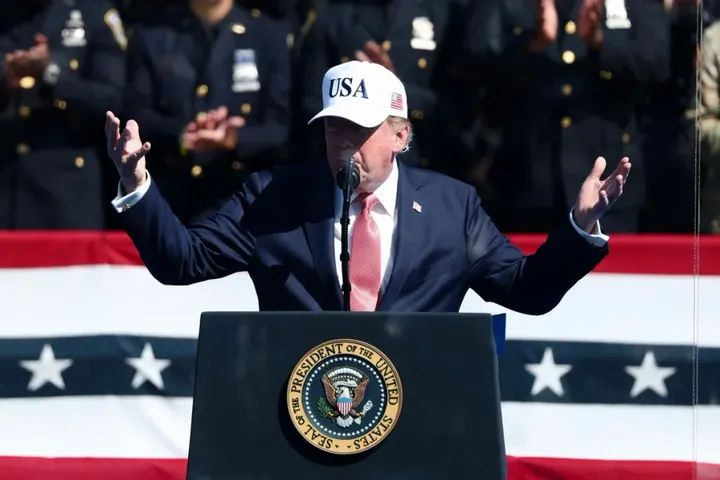
US President Donald Trump has blamed the Democratic Party’s sweeping victories in the November 3 midterm elections for a dramatic plunge in the American stock market, following one of Wall Street’s sharpest trading sessions in recent months. The Republican president made the remarks on Thursday, November 5, after major US stock indexes suffered significant losses, wiping out trillions of dollars in market value and raising fresh concerns among investors about the direction of the American economy. Trump took to his Truth Social platform to express his displeasure over the development, arguing that the electoral gains recorded by Democrats had triggered the market downturn.
In his post, Trump described Thursday’s market performance as one of the worst days in history, claiming that the election results were responsible for the losses suffered by investors. He also drew attention to the impact of the downturn on Americans’ retirement savings, particularly individuals whose investments are tied to the stock market through 401(k) retirement accounts. “The Stock Market suffered one of the Worst Days in History based on the results of the Election. Such a sad thing to watch! It took so much work to get us to a level that no one has ever seen before, and then this. Your 401(k)s have, therefore, dropped,” Trump wrote.
The president subsequently directed his criticism at the Democratic Party, using a derogatory spelling of the party’s name while insisting that Republicans should not be held responsible for the financial losses. “Remember, it wasn’t Republicans, it was Dumocrats,” he added. Trump, however, attempted to reassure investors that the situation would eventually improve, promising that the American stock market would recover and become stronger. “Do not fear, however, we will soon, one way or the other, be BIGGER AND STRONGER THAN EVER BEFORE,” he declared.Thursday’s trading session recorded substantial losses across the three major American stock market indexes. The Dow Jones Industrial Average plunged by 1,833 points, representing a decline of approximately 3.44 per cent, to close at 51,523.06. The S&P 500 also fell by 4.36 per cent to 7,353.73, while the technology-heavy Nasdaq Composite suffered an even steeper decline of 5.52 per cent, closing at approximately 24,315 points. The Nasdaq’s performance marked its worst percentage decline since April 2025, reflecting the extent of the pressure experienced by technology-related companies.
The downturn was particularly severe for companies associated with artificial intelligence, semiconductor production and the construction of large data centres. Nvidia, one of the world’s most influential artificial intelligence chip manufacturers, recorded a decline of more than nine per cent, while the Philadelphia Semiconductor Index, which tracks major semiconductor companies, plunged by more than 12 per cent. The heavy losses reflected growing concerns among investors about the possibility of stricter government oversight of artificial intelligence development and data-centre construction under the incoming Democratic-controlled Congress.
Market analysts suggested that the Democratic Party’s electoral success had contributed to uncertainty surrounding the future of the technology industry. Several Democratic candidates who secured victories during the midterm elections had expressed concerns about the rapid expansion of artificial intelligence infrastructure, particularly the enormous electricity consumption, environmental consequences and pressure that large data centres could place on local communities. Some politicians have also supported proposals to introduce stricter regulations or temporary restrictions on certain data-centre developments. Investors consequently became concerned that a Democratic-controlled Congress could introduce policies capable of slowing down the industry’s expansion.
The political implications of the midterm elections have also contributed to the changing atmosphere on Wall Street. Democrats recorded significant victories across several traditionally Republican-leaning states, capturing important Senate and House seats and securing control of both chambers of Congress. Their victories included major breakthroughs in South Carolina, North Carolina, Iowa, Kansas, Ohio, Texas and Maine. The outcome represents a significant shift in the balance of political power in Washington and is expected to increase congressional scrutiny of the Trump administration’s policies. With control of Congress, Democrats will have greater influence over legislative priorities, government investigations and oversight of federal agencies.
Interestingly, the stock market had initially responded positively to the election results before experiencing Thursday’s dramatic reversal. American stocks rallied on Wednesday, November 4, with the Dow Jones Industrial Average recording substantial gains as investors initially considered the possibility that political developments could produce a more balanced approach to economic policymaking. However, the optimism did not last, as concerns about potential regulatory changes, particularly within the artificial intelligence industry, became more prominent during Thursday’s trading session. The subsequent decline wiped out much of the previous day’s gains and intensified uncertainty across financial markets.
Beyond the political developments, analysts have also pointed to other economic concerns affecting investor confidence. The enormous amount of money being invested in artificial intelligence infrastructure, the borrowing required to finance data-centre projects, rising energy costs and questions about the long-term profitability of certain AI investments have all contributed to market uncertainty. Consequently, although Democratic victories provided an immediate political explanation for the downturn, the wider sell-off also reflects deeper concerns about the sustainability of the technology investment boom. The relationship between political decisions, government regulation and financial market performance remains particularly important as investors assess the future of the American economy.
Trump’s comments have further highlighted the importance he places on stock market performance as an indicator of his administration’s economic achievements. Throughout his presidency, he has frequently celebrated rising stock prices as evidence of investor confidence and economic progress. However, Thursday’s dramatic losses have presented his administration with fresh questions about market stability, the direction of technology investment and the potential economic consequences of the new political balance in Congress. Meanwhile, the decline in retirement investment portfolios has renewed concerns among ordinary Americans who depend on financial markets to support their long-term savings.
As the political consequences of the midterm elections continue to unfold, attention is now turning towards how the incoming Democratic-controlled Congress will approach artificial intelligence regulation, corporate oversight and economic policy. Whether the market downturn represents a temporary reaction to electoral uncertainty or the beginning of a more prolonged period of volatility remains to be seen. For now, Trump’s decision to blame Democrats has added another political dimension to Wall Street’s latest financial turmoil, demonstrating how electoral outcomes can influence investor expectations and the broader economic conversation in the United States.