Physical Address
304 North Cardinal St.
Dorchester Center, MA 02124
Physical Address
304 North Cardinal St.
Dorchester Center, MA 02124

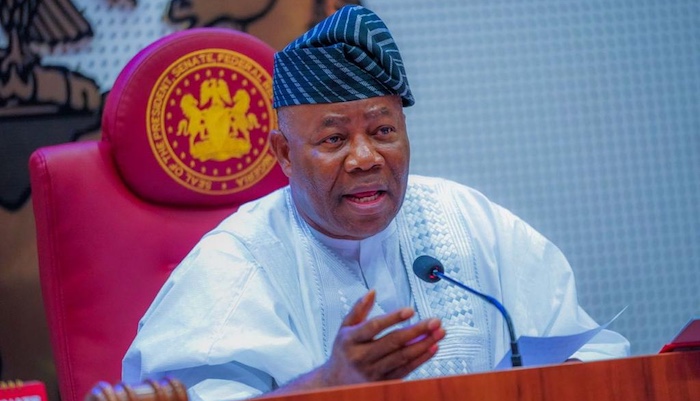
Nigeria’s Senate President, Godswill Akpabio, has called for stronger parliamentary relations between Nigeria and Australia, saying closer cooperation between the two legislatures could give greater depth and continuity to the bilateral relationship between both countries. Akpabio made the call in Abuja when the Speaker of the Australian House of Representatives, Milton Dick, paid a courtesy visit to the Nigerian Senate.
Akpabio noted that although Nigeria and Australia are geographically far apart, the two countries have several institutional similarities that provide room for deeper cooperation. Both are Commonwealth countries with federal systems and bicameral legislatures, while their multicultural societies and substantial natural resources also create areas where lawmakers can exchange experiences and ideas. According to the Senate President, those similarities should be used to move the relationship beyond traditional government-to-government diplomacy.
At the centre of Akpabio’s proposal is greater parliamentary diplomacy. He said relations between countries should not be left entirely in the hands of executive governments and diplomats, stressing that parliaments represent citizens and can provide a more sustained channel for engagement. He therefore proposed regular exchanges between Nigerian and Australian legislators, closer cooperation between parliamentary committees, exchanges involving parliamentary staff and periodic dialogue between the presiding officers of both legislatures.
The Senate President also welcomed the initiative to establish an Australia-Nigeria Parliamentary Friendship Group, describing it as an opportunity to create a structured platform for lawmakers from both countries to maintain regular contact. Other areas identified for possible cooperation include mining and critical minerals, agriculture, food security, education, renewable energy, technology, security and legislative capacity building. Akpabio said Nigeria could benefit from Australian experience in relevant sectors while Australia could also explore opportunities presented by Nigeria’s large population, market and natural resources.
The visit also touched on the Inter-Parliamentary Union, where Milton Dick is seeking the presidency of the international parliamentary organisation. Akpabio acknowledged Dick’s experience within the IPU and said Nigeria attaches importance to the organisation as a platform for parliamentary dialogue, democratic development, peace and international cooperation. The Senate President said the relationship between Nigeria and Australia could also serve as a bridge for stronger parliamentary engagement between Africa and the Pacific.
For Nigeria, the proposed exchanges could provide an avenue for lawmakers and parliamentary officials to compare legislative practices and discuss how different institutions approach issues such as committee oversight, lawmaking, public accountability and representation. The National Assembly itself identifies the Inter-Parliamentary Union and other international parliamentary bodies among its institutional affiliations, reflecting the wider role of parliamentary diplomacy in Nigeria’s external engagement.
The Australian delegation’s visit also comes at a time when parliamentary cooperation is increasingly being used to complement formal diplomatic relations. In Australia, parliamentary committees regularly examine international agreements and matters involving cooperation with other countries, providing one example of how legislative institutions can contribute to foreign-policy and international engagement.
Akpabio described Dick’s visit as an opportunity to renew the longstanding relationship between Nigeria and Australia. He recalled that Australia established its diplomatic mission in Nigeria in September 1960, shortly before Nigeria gained independence. The Senate President expressed confidence that the Australian Speaker’s visit would help open a new chapter in relations between the two countries, particularly through direct contact between their legislatures.
Dick, for his part, thanked the Nigerian Parliament for receiving him and spoke warmly about Nigeria’s role in Africa and the wider parliamentary community. His visit was partly connected to his campaign for the IPU presidency, and he sought the support of the Nigerian Parliament as the organisation prepares for its leadership election.
The proposed legislative exchanges therefore go beyond ceremonial visits. If implemented, regular meetings between committees, lawmakers and parliamentary officials could create a more consistent channel for both countries to share legislative experiences and discuss areas of mutual interest. For Akpabio, the objective is to make parliamentary diplomacy a more visible part of Nigeria-Australia relations and ensure that the connection between the two countries is maintained not only through their governments, but also through the institutions representing their citizens.