Physical Address
304 North Cardinal St.
Dorchester Center, MA 02124
Physical Address
304 North Cardinal St.
Dorchester Center, MA 02124

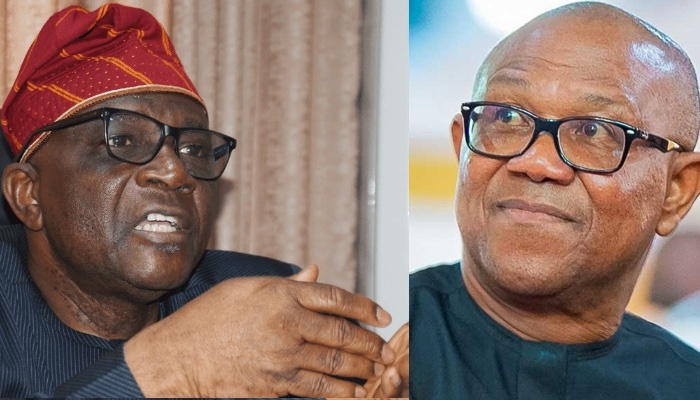
The political battle ahead of the 2027 presidential election is already gathering momentum, and the latest exchange has once again brought former Anambra State Governor and presidential hopeful Peter Obi into the centre of political controversy.
Bayo Onanuga, Special Adviser to President Bola Tinubu on Information and Strategy, has taken a direct swipe at Obi, describing him as “overhyped and overrated” and questioning whether his political record is strong enough to justify the confidence placed in him by his supporters.
Onanuga made the remarks in a post on his X handle on Saturday while reacting to the growing expectations surrounding Obi’s 2027 presidential ambition. According to the presidential aide, supporters of the former Anambra governor appear to believe that Obi could somehow perform a miracle if given the opportunity to govern Nigeria. Onanuga, however, argued that running a country as complex as Nigeria requires more than popularity, social-media enthusiasm or the ability to attract a large following.
“Governance is not by magic,” Onanuga argued, insisting that anyone seeking the highest political office in the country should be able to point to a convincing record of governance and demonstrate the capacity to perform at a national level.
The presidential aide went further, describing Obi as “clueless” and alleging that his tenure as governor of Anambra State was a “spectacular failure.” He also questioned what he described as inconsistencies in Obi’s political positions, suggesting that the former governor’s national appeal has grown much faster than what his record in public office, in Onanuga’s assessment, can justify.
The comments are particularly significant because Obi has remained one of the most discussed opposition figures in the build-up to the 2027 election. His political rise received enormous attention during the 2023 presidential election, when he contested on the Labour Party platform and emerged as a major force among younger Nigerians and urban voters. He has since remained at the centre of discussions about a possible alternative to the established political parties.
But Onanuga’s argument goes beyond popularity. His central question is whether the enthusiasm surrounding Obi can be translated into the kind of broad administrative and political capacity required to govern Nigeria. In other words, can the political energy that surrounds Peter Obi be converted into effective national governance?
That question is likely to remain one of the major issues of the 2027 campaign.
Obi’s supporters, on the other hand, have consistently pointed to his experience as governor of Anambra and his reputation for fiscal discipline, infrastructure development and a comparatively frugal approach to government as evidence that he has the administrative experience necessary for the presidency. His supporters also argue that his performance should not be judged solely by the standards traditionally applied to Nigerian politicians, particularly in a political environment where public confidence in established political structures has declined.
Obi served as governor of Anambra State for several years, including a period following his reinstatement by the courts after his earlier removal from office. He later completed another term before handing over to Willie Obiano in 2014.
That history provides the basis for one of the central arguments in the emerging 2027 debate: is Obi’s record in Anambra sufficient evidence that he can successfully manage Nigeria at the federal level?For Onanuga, the answer appears to be no.
The timing of the attack also gives it additional political weight. With the 2027 presidential contest gradually taking shape, political actors are increasingly scrutinising the records, statements and past decisions of the leading contenders. The contest is no longer simply about who enjoys the loudest support online; questions about experience, economic policy, security, infrastructure, institutional reform and the ability to build a national coalition are likely to dominate the political conversation.
Onanuga’s intervention therefore reflects a broader strategy by the Presidency to challenge the narrative surrounding opposition figures before the campaign becomes even more intense.
It is also worth noting that Onanuga’s criticism is coming from a senior official within the Tinubu administration, meaning that his assessment is inevitably political. His description of Obi as “overhyped,” “overrated” and “clueless” should therefore be understood as a political argument rather than an independently established fact. The strength of that argument will ultimately be tested against Obi’s record, the policies proposed by both camps and, most importantly, the judgment of Nigerian voters.
As the 2027 election approaches, the political conversation is likely to become increasingly heated. Obi’s supporters will insist that his record and political movement represent a departure from the old order, while his critics will continue to ask whether his popularity is greater than his demonstrated capacity to govern a country of more than 200 million people.
For now, Onanuga has thrown down the gauntlet. His message is straightforward: popularity is not the same thing as capacity, and national leadership cannot be built on hype alone.
Whether Nigerians agree with him—or whether Obi’s supporters can successfully prove the opposite—will be one of the defining political arguments of the road to 2027.