Physical Address
304 North Cardinal St.
Dorchester Center, MA 02124
Physical Address
304 North Cardinal St.
Dorchester Center, MA 02124

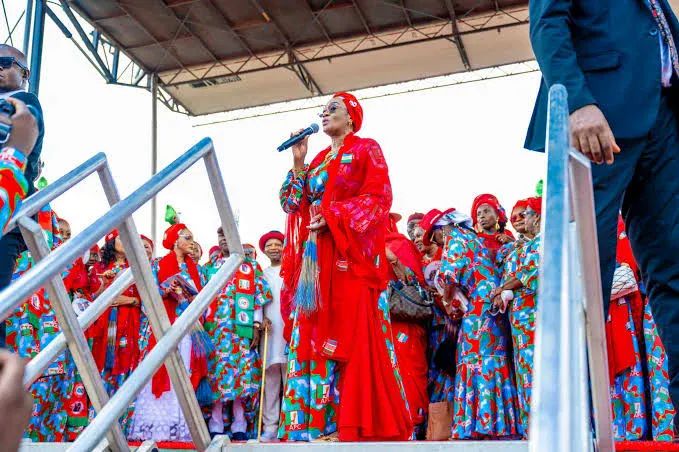
Nigeria is now entering an era of prosperity following a period of difficult economic reforms, First Lady Senator Oluremi Tinubu has declared. The First Lady expressed optimism about the country’s economic direction, suggesting that the sacrifices associated with the Federal Government’s reform policies would begin to translate into improved living conditions and greater opportunities for Nigerians. Her declaration comes amid ongoing national conversations about the effectiveness of President Bola Ahmed Tinubu’s economic policies, the rising cost of living and the expectations of millions of citizens who are eager to see tangible improvements in their daily lives.
According to the First Lady, the country has moved beyond the most difficult phase of economic adjustments and is now approaching a period in which the benefits of reforms can become more visible. Her remarks reflect the administration’s position that some of its major economic decisions were necessary to establish a more sustainable foundation for national development. The government has consistently argued that reforms involving public spending, foreign exchange management and the petroleum sector are intended to correct long-standing structural weaknesses and create an environment that supports investment and economic growth.
Since President Tinubu assumed office in May 2023, his administration has implemented several major economic policies, including the removal of the petrol subsidy and changes to the foreign exchange system. The government has defended these decisions as necessary measures to reduce fiscal pressure, improve the allocation of public resources and address distortions within the economy. However, the policies also contributed to significant increases in transportation, food and other living costs, placing considerable pressure on households and businesses. For many Nigerians, the central question remains whether the expected long-term benefits will outweigh the immediate hardships experienced during the adjustment period.
The First Lady’s optimism comes at a time when the administration faces pressure to demonstrate that its economic programme is producing measurable results. While government officials have pointed to reforms and investment initiatives as signs of progress, many citizens continue to struggle with high prices, reduced purchasing power and the difficulty of meeting basic household expenses. Workers, students, traders, farmers and small-business owners have all felt the effects of the changing economic environment in different ways. Consequently, the promise of prosperity will be judged not only by official statements or economic projections but also by improvements in the everyday experiences of ordinary Nigerians.One area in which Nigerians will expect visible progress is employment generation. A prosperous economy should provide opportunities for young people to secure decent jobs, establish businesses and develop skills that enable them to participate meaningfully in national development. Nigeria has a large and energetic youth population, but unemployment, underemployment and limited access to capital remain major concerns. If the government’s reforms successfully stimulate private investment and productive economic activity, they could create opportunities across sectors such as agriculture, manufacturing, technology, transportation and services. The challenge will be ensuring that the benefits of growth reach people across different income groups and regions.
Food security and the cost of living will also remain central to public assessments of the administration’s performance. The prices of essential food items have become a major concern for households, particularly those whose incomes have not increased at the same pace as living expenses. Sustainable prosperity would require stronger agricultural production, improved storage and distribution systems, better rural roads and measures to reduce avoidable costs along the food supply chain. Greater investment in farming, irrigation, processing and transportation could help strengthen domestic food supplies while creating employment opportunities for rural communities. Nigerians will expect any improvement in the wider economy to be reflected in more affordable food and better access to essential goods.
Infrastructure development is another important factor in determining whether the country can achieve the prosperity described by the First Lady. Reliable electricity, functional roads, efficient transport networks, modern healthcare facilities and quality educational institutions are essential to improving productivity and attracting investment. Businesses cannot operate efficiently when energy costs are excessively high, transportation is unreliable or access to essential public services remains limited. The government’s ability to expand infrastructure while ensuring transparency and responsible use of public funds will therefore be critical to converting economic reforms into sustainable development. Such investments must also be implemented in ways that produce measurable benefits for communities rather than remaining promises on paper.
The administration’s reform agenda has also generated debate about the distribution of economic gains and the protection of vulnerable citizens. While some sectors may benefit from improved market conditions or increased investment, low-income households can remain exposed to inflation and other economic pressures. For prosperity to be meaningful, growth must be inclusive and accompanied by policies that improve access to education, healthcare, housing and social protection. Effective implementation of support programmes, alongside opportunities for productive employment, could help ensure that economic recovery does not benefit only a limited section of the population. Public confidence will depend partly on whether citizens believe the sacrifices demanded by the reforms are being shared fairly.
The First Lady’s declaration also carries political significance as Nigeria moves closer to the 2027 general elections. Economic performance is likely to remain one of the most important issues influencing voters’ assessments of President Tinubu’s administration. Supporters of the government may argue that difficult reforms require time before their full benefits become apparent, while critics may insist that the administration must do more to ease the immediate burden on citizens. Both perspectives are likely to feature prominently in public debate as political parties present their records, promises and economic alternatives. Ultimately, the government’s claims of progress will be measured against concrete outcomes, including inflation trends, household purchasing power, job creation, investment and the overall quality of life.
As Nigeria looks towards the future, Oluremi Tinubu’s assertion that the country is entering an era of prosperity expresses the administration’s confidence that its economic reforms can produce lasting benefits. However, turning that optimism into a reality will require sustained policy implementation, responsible governance, greater productivity, investment in infrastructure and effective protection for vulnerable citizens. Nigerians will hope to see economic progress reflected in more affordable living costs, better employment opportunities, stronger businesses and improved public services. Whether the country has truly entered a period of prosperity will ultimately depend not on declarations alone, but on the extent to which ordinary people experience meaningful and lasting improvements in their lives.