Physical Address
304 North Cardinal St.
Dorchester Center, MA 02124
Physical Address
304 North Cardinal St.
Dorchester Center, MA 02124


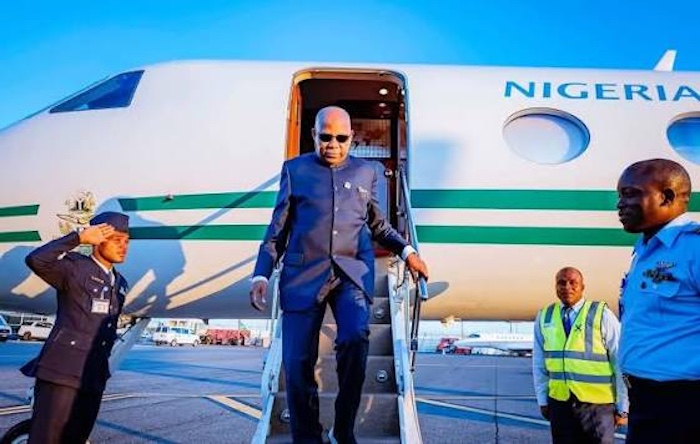
The prolonged stay of President Bola Ahmed Tinubu outside Nigeria has triggered fresh questions from former Vice President Atiku Abubakar, former Anambra State governor Peter Obi and the African Democratic Congress (ADC), with opposition figures demanding greater clarity about the President’s whereabouts, the constitutional arrangements surrounding his absence and his decision not to personally attend the 81st United Nations General Assembly in New York.
Tinubu left Nigeria on August 30, 2026, initially for what the Presidency described as a three-week working vacation. He travelled first to London before moving to Paris, France. On September 21, the Presidency announced that the President had extended his stay abroad by several days and was expected to return to Nigeria at the weekend.
The extension has, however, generated a political debate over the constitutional implications of a prolonged presidential absence. Atiku Abubakar, who is now the presidential candidate of the ADC, asked what constitutional arrangements were in place while Tinubu remained outside the country and questioned whether the required procedure under Section 145 of the 1999 Constitution had been followed.
Section 145 provides for the President to transmit a written declaration to the President of the Senate and the Speaker of the House of Representatives when proceeding on vacation or otherwise unable to discharge the functions of his office. Where the constitutional conditions specified in the section are met, the Vice-President is to perform the functions of the President as Acting President. The ADC has specifically asked whether such a declaration was transmitted in the present circumstances.
The issue became more prominent because Vice-President Kashim Shettima also travelled outside Nigeria. Shettima left for New York to represent Nigeria at the 81st United Nations General Assembly, meaning both the President and Vice-President were abroad at the same time. The ADC subsequently questioned who was formally exercising presidential authority while the two constitutional office holders were outside the country.
The party has also challenged the role being played by Secretary to the Government of the Federation, George Akume, who has represented the President at some official engagements in Nigeria. The ADC’s argument is that administrative representation at official events is different from the constitutional transfer or exercise of presidential powers. That is the party’s position; the Presidency has maintained that governance has continued without disruption.
Atiku had also raised questions over Tinubu’s absence from the United Nations General Assembly. The 2026 gathering marks the third consecutive UNGA that Tinubu has not personally attended. He was also absent from the 79th UNGA in 2024 and the 80th in 2025, with Vice-President Shettima representing Nigeria on those occasions.
Atiku argued that although the Vice-President can represent the country, repeated delegation of the President’s attendance at such a major diplomatic gathering raises questions about Nigeria’s visibility and engagement at the highest level of international diplomacy. The Presidency, however, has rejected the suggestion that Tinubu’s absence weakens Nigeria’s representation, maintaining that Shettima has a full mandate to represent the country at the UNGA.
Peter Obi has also joined the conversation. The former Anambra governor questioned Tinubu’s continued absence from Nigeria and his non-attendance at the 81st UN General Assembly. In a statement released on September 27, Obi asked, “Where is Nigeria’s President?”, pointing to the importance of Nigeria’s participation in major international engagements.
Obi’s comments came after he watched an address by Ghanaian President John Dramani Mahama at the UN General Assembly. He contrasted Nigeria’s absence at the presidential level with Ghana’s participation and argued that Nigeria, as Africa’s most populous country, should have a visible presence at important global forums. These are Obi’s political arguments, rather than an independent assessment of the consequences of Tinubu’s absence.
The Presidency has responded to the criticism by insisting that Tinubu remains in charge of government despite being abroad. Presidential spokesperson Bayo Onanuga said the President was “hale and hearty” and described the trip as a working vacation. He also argued that modern communication technology allows the President to direct government affairs without being physically present in Abuja.
The Presidency has further pointed to Tinubu’s meetings in France as evidence that the President has continued to work during his stay abroad. Onanuga said Tinubu had been meeting investors and cited his involvement in facilitating a proposed $7 billion deep-sea port project in Ogun Waterside.
The government has also defended Shettima’s presence at the UNGA. The Presidency said the Vice-President was carrying the President’s full mandate and would properly represent Nigeria at the international gathering. Nigeria’s Permanent Representative to the United Nations, Jimoh Ibrahim, similarly argued that the President’s absence should not be interpreted as a failure of Nigerian representation, noting that Shettima and the Foreign Affairs Minister were participating in the diplomatic engagements.
The constitutional question, however, remains at the centre of the opposition’s criticism. The ADC has called on both the Presidency and the National Assembly to clarify the formal arrangements governing the exercise of presidential powers during Tinubu’s extended absence. The party has particularly focused on Section 145 and the procedure for transmitting presidential functions to the Vice-President.
The debate is also taking place against the backdrop of Nigeria’s economic and security challenges. Opposition figures have argued that the country requires clear leadership and public communication during a period marked by economic pressure, insecurity and concerns about the cost of living. The Presidency, on the other hand, maintains that Tinubu has remained engaged with affairs in Nigeria and that his physical absence has not prevented government from functioning.
For now, the two sides remain sharply divided over the significance of the President’s prolonged stay abroad. The opposition is demanding more information about his location, the constitutional status of his absence and the arrangements for exercising presidential authority, while the Presidency says Tinubu is working from abroad and remains fully in charge of the government.
As the controversy continues, the central issue is not simply where the President is physically located, but what formal constitutional arrangements govern the exercise of executive authority whenever a Nigerian President is away from the country for an extended period. That question has now become part of the wider political conversation as Nigeria heads toward the 2027 general elections.