Physical Address
304 North Cardinal St.
Dorchester Center, MA 02124
Physical Address
304 North Cardinal St.
Dorchester Center, MA 02124
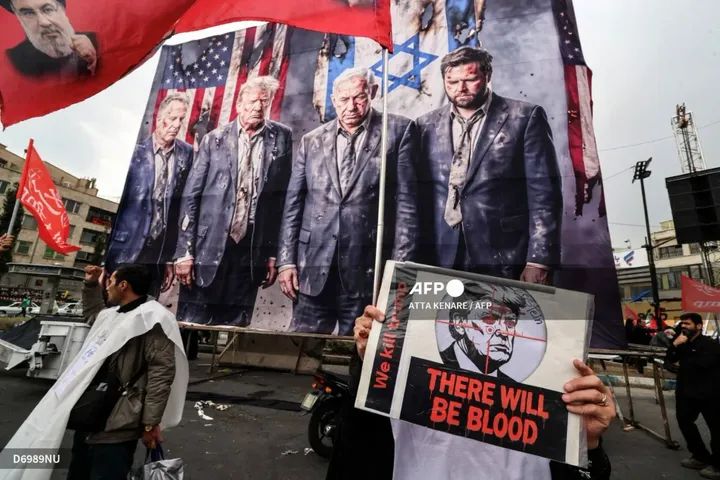
Iran has unveiled a massive billboard and banners in Tehran carrying a threatening message directed at United States President Donald Trump, amid renewed calls for revenge over the killing of a prominent Iranian leader. The display has drawn international attention because of its threatening language and the already strained relationship between Tehran and Washington. The development underscores the continuing hostility between the two countries, whose disputes over security, regional influence and military actions have repeatedly raised concerns about the possibility of further confrontation.
The billboard, displayed in the Iranian capital, reportedly contains imagery and wording interpreted as a direct threat against Trump. Its appearance comes amid heightened political tensions and renewed expressions of anger among sections of Iran’s political establishment and public over the death of a leader associated with the country’s leadership. Such public displays can serve as political messaging, communicating defiance to foreign governments while reinforcing domestic narratives about national sovereignty, retaliation and resistance to perceived external aggression.
The reported threat against Trump is particularly significant given the history of antagonism between Iran and the United States. Relations between the two countries have deteriorated over decades, with disagreements involving Iran’s nuclear programme, economic sanctions, regional security and Washington’s military partnerships in the Middle East. Both governments have frequently accused each other of undermining regional stability, while diplomatic efforts to ease tensions have faced repeated setbacks.
Calls for revenge over the slain Iranian leader have added another dimension to the dispute. In Iran, the death of influential political and military figures can become a rallying point for public demonstrations and official statements promising that those considered responsible will face consequences. However, the language of retaliation can also intensify tensions, particularly when directed at senior foreign officials or accompanied by imagery that appears to encourage violence.Trump has been a central figure in the deterioration of US-Iran relations, particularly because of decisions taken during his first presidency. His administration withdrew the United States from the 2015 nuclear agreement with Iran in 2018 and subsequently restored and expanded sanctions against Tehran. The move sharply increased tensions, with Iranian officials arguing that Washington had abandoned its commitments and undermined diplomatic efforts to resolve the nuclear dispute.
One of the most consequential episodes in the relationship occurred in January 2020, when a US drone strike near Baghdad International Airport killed Iranian Major General Qassem Soleimani, the commander of the Islamic Revolutionary Guard Corps’ Quds Force. The strike triggered widespread anger in Iran and demands for retaliation against the United States. Iran subsequently launched missile attacks on bases housing US forces in Iraq, although the immediate exchange did not develop into a full-scale war between the two countries.
The billboard’s reported message also raises questions about the role of political propaganda and public communication during periods of international tension. Governments and political movements have historically used posters, murals, banners and public installations to communicate opposition to foreign leaders or policies. While such displays may be intended to demonstrate resolve or mobilise domestic support, threats against identifiable individuals can further inflame hostility and complicate attempts to reduce diplomatic tensions.
Washington is likely to view any explicit threat against a former or sitting American president as a serious security concern, although the appearance of a billboard alone does not establish that an operational plan to carry out an attack exists. Distinguishing political rhetoric from credible preparations for violence is essential when assessing such incidents. Any assessment of a genuine threat would depend on additional evidence, including intelligence, statements from responsible authorities and indications of concrete preparations.
The development also comes against the broader backdrop of instability in the Middle East, where confrontations involving Iran, Israel, the United States and regional armed groups have repeatedly threatened to widen into larger conflicts. Public threats and retaliatory declarations can narrow the space for diplomatic engagement, especially when political leaders face domestic pressure to respond forcefully to attacks or the deaths of prominent figures. At the same time, international observers continue to stress the importance of avoiding actions that could trigger further violence and endanger civilians.
As the billboard attracts attention, the central question is whether the display will remain a symbolic expression of anger or become part of a wider escalation in hostile rhetoric between Tehran and Washington. The message reflects the depth of resentment surrounding the disputes between the two countries, but its practical implications will depend on subsequent official statements and developments. For now, the reported threat highlights the fragile nature of US-Iran relations and the risks that confrontational political messaging can pose in an already volatile international environment.