Physical Address
304 North Cardinal St.
Dorchester Center, MA 02124
Physical Address
304 North Cardinal St.
Dorchester Center, MA 02124

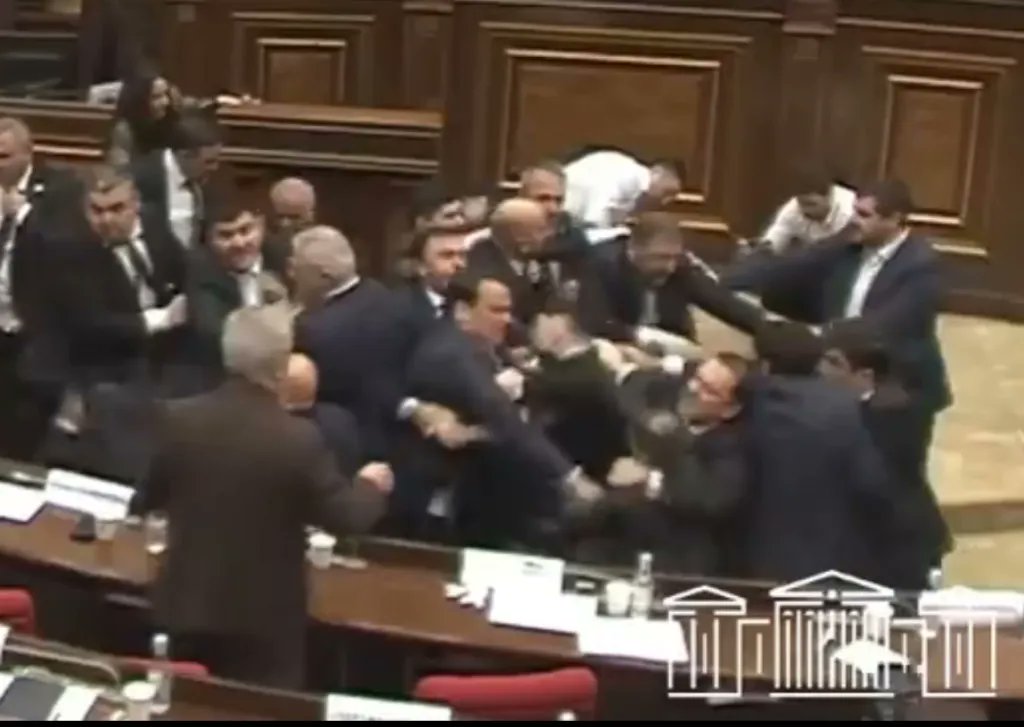
Armenia’s parliament descended into chaos after lawmakers from the ruling party and the opposition exchanged punches, threw objects and engaged in a physical confrontation following a heated political dispute over a controversial proposal to establish a government ministry intended to address women’s sexual dissatisfaction. The incident, which occurred during a parliamentary session on Thursday, October 29, 2026, attracted international attention after videos showing lawmakers fighting inside the legislative chamber circulated widely on social media. The confrontation involved members of the ruling Civil Contract party and the opposition Strong Armenia faction, exposing the growing political tensions between the two camps.
The incident reportedly began during a debate concerning the appointment of a member to Armenia’s Audit Chamber. Taron Chakhoyan, a lawmaker from the ruling Civil Contract party, was addressing the National Assembly when he referred to an earlier controversial statement made by Sargis Karapetyan, a relative of opposition politician Narek Karapetyan. Chakhoyan questioned why the opposition figure’s relative had not apologised for the remarks surrounding the proposed ministry. What began as a political criticism quickly developed into a heated exchange between lawmakers, eventually escalating into physical violence.
At the centre of the controversy was an earlier suggestion that Armenia could establish a government department focused on addressing women’s sexual dissatisfaction. Sargis Karapetyan had previously discussed the idea in connection with the country’s demographic challenges, arguing that personal fulfilment and relationships could be linked to population growth. The proposal was widely described in media reports as a proposed “Ministry of Sex.” However, the ministry was not the subject of a formal legislative vote during the parliamentary session in which the fighting occurred; rather, the earlier remarks were brought up during a separate debate and became the immediate trigger for the confrontation.
Chakhoyan’s comments reportedly provoked an angry reaction from Narek Karapetyan, who leads the opposition Strong Armenia faction. Karapetyan interrupted the ruling-party lawmaker and responded from his seat before approaching the podium, according to reports of the incident. The verbal confrontation soon became physical, drawing in other lawmakers from both political camps. Members were seen pushing and striking one another as the disorder spread across the chamber, turning an ordinary parliamentary proceeding into a scene of confusion.
Footage from the National Assembly showed lawmakers exchanging punches and kicks, while some threw objects, including chairs, during the confrontation. In one particularly dramatic moment, Armenia’s Deputy Speaker, Vahagn Aleksanyan, was seen throwing a chair towards opposition lawmakers. Other legislators rushed towards the centre of the dispute, while several struggled to separate those involved. The incident reportedly continued beyond the immediate area of the parliamentary podium, prompting security personnel to intervene and efforts to restore order within the legislative complex.
The confrontation also raised concerns about the safety of lawmakers and the conduct expected of elected representatives. Reports indicated that some parliamentarians sustained injuries during the altercation, with an ambulance reportedly called to the parliamentary building. Images and videos showing lawmakers with torn clothing and visible injuries circulated after the incident. The parliamentary session was eventually interrupted as officials attempted to bring the situation under control. The scenes attracted criticism because the National Assembly, as the country’s principal legislative institution, is expected to provide a platform for resolving political disagreements through debate rather than physical confrontation.
Armenian parliamentary speaker Ruben Rubinyan subsequently placed responsibility for the incident on opposition faction leader Narek Karapetyan and other opposition lawmakers. Rubinyan said he had reviewed footage of the confrontation and argued that Karapetyan had interrupted the ruling-party lawmaker’s speech before approaching him in an aggressive manner. He also accused opposition lawmaker Garnik Davtyan of striking Chakhoyan during the altercation. These were the speaker’s public allegations regarding how the confrontation began, while the incident itself involved lawmakers from both sides of the political divide.
Prime Minister Nikol Pashinyan also reacted to the incident, condemning violence while expressing support for the actions of members of his ruling Civil Contract faction. His response generated further controversy because, despite condemning physical confrontation in principle, he described his party’s response as justified and proportionate to the circumstances. The remarks intensified debate over political responsibility and whether elected officials should face consequences for participating in violence inside parliament. The episode has also drawn attention to the increasingly confrontational relationship between Armenia’s governing party and opposition groups.
The opposition, meanwhile, defended its position amid the continuing political disagreement. Narek Karapetyan reportedly characterised the confrontation as a normal occurrence in parliamentary life, arguing that disagreements between politicians with opposing views were not unusual. However, the incident has renewed questions about the limits of political confrontation, the responsibility of public officials and the importance of maintaining order in democratic institutions. While lawmakers are entitled to challenge one another’s policies and statements, physical violence risks undermining public confidence in the legislative process and diverting attention from substantive national issues.
The Armenian parliamentary brawl has therefore become more than a controversy surrounding an unusual proposal about relationships and population growth. It has highlighted the depth of political divisions between the ruling Civil Contract party and the opposition Strong Armenia faction, as well as the consequences when political disagreements escalate beyond verbal exchanges. The incident has also placed the conduct of elected representatives under international scrutiny, particularly as footage of the confrontation continues to circulate online. Ultimately, Armenia’s parliament faces the challenge of restoring confidence in its proceedings and ensuring that future disagreements are resolved through lawful debate, evidence and democratic accountability rather than punches, thrown chairs and public disorder.