Physical Address
304 North Cardinal St.
Dorchester Center, MA 02124
Physical Address
304 North Cardinal St.
Dorchester Center, MA 02124
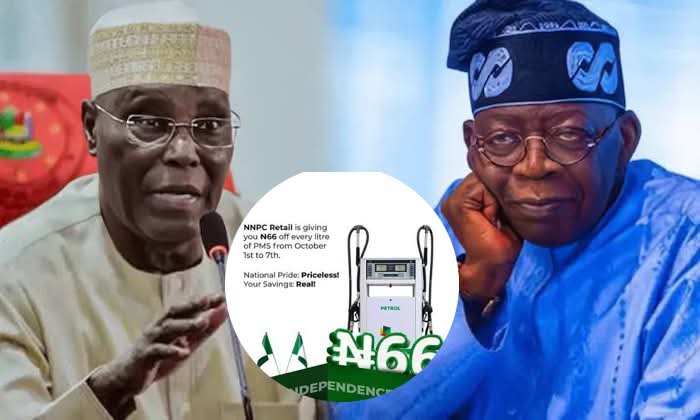
Former Vice President and African Democratic Congress (ADC) presidential candidate, Atiku Abubakar, has criticised President Bola Tinubu’s administration over the 30-day petrol discount introduced at Nigerian National Petroleum Company Limited (NNPC Ltd) retail stations, questioning the financial arrangements behind the initiative and accusing the government of seeking political credit for a temporary reduction in fuel prices.
Atiku argued that Nigerians deserve clear explanations about who will bear the cost of the ₦66-per-litre discount, whether the decision received the necessary corporate approval and how the intervention will benefit motorists who cannot easily access NNPC filling stations.
The former vice president’s criticism comes amid continuing public concern over petrol prices and the cost of living, with fuel expenses affecting transportation, food distribution, electricity generation and the daily operations of businesses across the country.
In a statement issued through Phrank Shaibu, Director of Strategic Communication of the ADC Presidential Campaign Council, Atiku accused the Tinubu administration of turning a measure intended to provide temporary relief into a political publicity exercise at the expense of NNPC Limited.
“Tinubu wants Nigerians to cheer for ₦66 off a litre before they ask who ordered NNPC to surrender the money,” Atiku said, according to the statement reported by TheCable on October 10, 2026.
He argued that the government was seeking public recognition for the price reduction without providing sufficient information about the approval process, the financial implications for the company and the account through which the cost would be recorded.
Atiku Questions Who Will Pay for the Discount
One of Atiku’s central concerns is the financial responsibility for the discount.The ADC presidential candidate questioned whether NNPC Limited’s management and board approved the decision before the announcement and whether the company would absorb the reduction from its commercial margins.
His argument centres on the legal and commercial status of NNPC Limited following the enactment of the Petroleum Industry Act 2021, which established the framework for the company’s transition from the former state-owned corporation into a commercial entity.
Atiku maintained that the company should not be treated as an informal source of funds for political announcements. In his view, any decision that reduces its revenue or affects its commercial operations should be supported by transparent procedures and a clear explanation of the financial arrangements involved.
He also challenged the government to explain whether it was exercising its rights as a shareholder through the appropriate corporate channels or expecting the company to absorb the cost of a policy announced by the Presidency.
These questions, he argued, are important because a reduction in the selling price does not eliminate the underlying cost of providing the product. Somebody must ultimately bear the difference, whether through a company’s margins, a government-funded arrangement or another commercial mechanism.
Atiku therefore wants the administration to explain how the discount will be financed and reflected in NNPC Limited’s accounts.His criticism is not simply about whether motorists should pay less for petrol. It also concerns the relationship between government policy and the financial independence of a company that operates within Nigeria’s petroleum industry framework.
The government and NNPC Limited, however, have presented the initiative as a temporary relief measure rather than a return to the former nationwide petrol subsidy regime.
Why the Government Introduced the 30-Day Petrol Discount
The Federal Government announced the discount amid pressure on petrol prices and the broader cost of living.On October 8, Finance Minister and Coordinating Minister of the Economy, Taiwo Oyedele, announced that the government would offer a petrol discount at NNPC retail stations for an initial period of 30 days, with public transport operators receiving priority.
Oyedele explained that the arrangement was not a reintroduction of the former petrol subsidy. Instead, he described it as an intervention intended to allow NNPC Limited to sell petrol at cost during the period.
The announcement came as rising fuel prices continued to put pressure on households and businesses. Petrol is a major input in Nigeria’s transportation system, while many small businesses depend on petrol-powered generators to maintain their operations amid unreliable electricity supply.
When fuel prices rise, the consequences frequently extend beyond the filling station. Transport operators may increase fares to cover their operating expenses, traders face higher costs for moving goods, and businesses may adjust their prices to compensate for increased production and distribution expenses.
For ordinary households, these increases can mean spending more on transportation, food and other essential goods even when their income remains unchanged.
The government’s stated objective is to provide some immediate relief during a period of elevated fuel prices. NNPC Limited has also said that the discount is intended to cushion the effects of higher global crude oil prices and their impact on domestic petrol costs.According to the company, the initiative began on October 1 as part of activities marking Nigeria’s 66th Independence Anniversary and was subsequently extended to October 31 following the government’s announcement.
NNPC Limited has insisted that the arrangement does not amount to restoring petrol subsidies and does not establish a uniform pump price across the country. The discount applies to its retail outlets, while the wider market-based pricing framework remains in place.
The distinction matters because the government is presenting the measure as a limited intervention rather than a reversal of the fuel subsidy removal announced by Tinubu in May 2023.
Atiku, however, believes that the government has not adequately explained the financial implications of the policy or demonstrated that the intervention will provide meaningful relief across the country.
Atiku Questions the Reach of NNPC Filling StationsBeyond the issue of who will finance the discount, Atiku has questioned whether the initiative can reach enough Nigerians to justify the government’s announcement.
He pointed to the size of NNPC Retail’s network, which he said comprises just over 900 filling stations, and questioned whether that network could adequately serve a population of approximately 242 million people.
His concern is that the discount may be available only to motorists who can conveniently reach participating NNPC stations, leaving many other Nigerians to purchase petrol at prevailing prices elsewhere.
The issue is particularly relevant in areas where NNPC retail outlets are limited or situated far from residential communities and commercial centres.
For a motorist living close to an NNPC station, saving ₦66 per litre could offer a modest benefit. But for someone who must travel a considerable distance to access the discount, the additional fuel consumed and time spent on the journey could reduce the actual savings.
Atiku also raised concerns about queues and the process motorists may have to follow to access the offer, including the use of an application and payment arrangements associated with the discount.
He questioned whether it made economic sense for a driver to spend additional money travelling to a designated station, wait in a queue and complete the required process merely to save ₦66 per litre.
These are questions about the practical reach of the intervention rather than simply its announced value. A discount can look attractive on paper, but its usefulness to individual consumers depends on accessibility, availability and the amount they ultimately save.
The experience may also differ between private motorists and commercial transport operators. A transport operator who purchases large quantities of petrol could potentially benefit more from a per-litre reduction than a motorist who buys only a small quantity occasionally.
However, the broader economic effect would depend on whether those savings translate into lower transport fares or reduced prices for goods and services.
Atiku has argued that the government has yet to provide adequate guarantees that savings made by transport operators will be passed on to passengers.
Without such a mechanism, commuters could continue paying existing fares even while some operators obtain petrol at a discounted rate.
The administration has said public transporters will receive priority, but the precise extent to which the discount will reduce fares across different routes remains an important question for consumers.
The Political Dispute Over Fuel SubsidyThe controversy has also reopened the political debate surrounding the removal of petrol subsidies and the economic policies adopted by the Tinubu administration.
When Tinubu announced the removal of the petrol subsidy in May 2023, the government defended the decision as necessary to address the financial burden of the subsidy system and redirect public resources towards other priorities.
The announcement was followed by sharp increases in petrol prices, placing considerable pressure on transportation costs and household spending.
The government has maintained that removing the subsidy was part of a broader effort to reform the economy. Critics, however, have repeatedly questioned whether sufficient measures were introduced to protect low-income households from the immediate effects of the policy.
Atiku has been among those advocating a different approach to fuel-price relief.
He argues that the government should consider a transparent, properly budgeted production-support arrangement linked to petrol refined in Nigeria. Under the proposal he has described, support would be designed to reduce the cost of qualifying locally refined fuel while establishing safeguards to ensure that the benefit reaches consumers and supports domestic refining.
The ADC candidate believes that such an arrangement would be more sustainable than a short-term discount restricted to one retail network.
He has also accused the Tinubu administration of adopting an intervention resembling his earlier proposal while limiting it to a temporary 30-day arrangement.
Speaking in Abuja on Friday, October 9, during the inauguration of the ADC Presidential Campaign Council, Atiku accused the President of borrowing the idea of production support but reducing it to a short-term measure.
He argued that a temporary discount does not address the wider question of how Nigeria can achieve more affordable petrol prices without creating another poorly explained financial burden.
Atiku’s position is that Nigerians need a policy with clearly defined funding, measurable objectives and sufficient duration to provide meaningful relief.
The Tinubu administration, on the other hand, has defended the current discount as a temporary response to prevailing market pressures and has rejected the suggestion that it represents a return to the former subsidy arrangement.
The disagreement therefore reflects two competing approaches to petrol-price relief: a limited, time-bound discount at NNPC stations and a more structured production-support arrangement proposed by Atiku.
What Happens When the 30 Days End?Another major question raised by Atiku is what will happen when the discount expires.
The initiative is scheduled to run until October 31, according to NNPC Limited’s announcement. Unless the arrangement is extended or replaced by another measure, motorists will have to contend with the prevailing pricing system after that date.
Atiku has argued that the government cannot provide relief for one month and expect that measure alone to resolve the economic pressures confronting Nigerians.
He questioned what would happen on the thirty-first day, when the discount ends but the cost of transportation, food and other essential goods may remain high.
The concern is that a temporary reduction may ease some pressure without changing the underlying factors responsible for high fuel prices.
These factors include global crude oil prices, exchange-rate movements, refining and distribution costs, and conditions within the domestic petroleum market.
Even if the discount provides some immediate savings, its long-term effect on household spending will depend on what happens to petrol prices after the intervention ends and whether other economic pressures begin to ease.
For transport operators, the end of the discount could also affect operating expenses. If petrol prices rise again, some may seek to adjust fares to protect their earnings.
For businesses, the question is whether the temporary savings will be sufficient to influence the prices of goods and services or whether the impact will be too limited to make a lasting difference.
Atiku’s criticism is that the government has not demonstrated how the 30-day measure fits into a wider plan to make fuel more affordable over the longer term.
A temporary intervention can provide immediate assistance, but it is not necessarily a substitute for policies that address the causes of high prices and the wider cost of living.
The government’s position is that the discount is intended to offer relief under current market conditions, not to replace the existing pricing framework. The effectiveness of the intervention will therefore depend partly on the level of savings consumers actually receive and what follows after October 31.Questions Over Transparency and Public Accountability
Atiku’s challenge has placed transparency at the centre of the debate.
His demand for clarification over board approval, the financial cost of the discount and the accounting arrangements raises questions about how major commercial decisions involving a state-owned company should be communicated to the public.
For many Nigerians, the immediate concern is the price displayed at the filling station. But for a company operating commercially, the implications of a price reduction also include revenue, operating costs, margins and the obligations it must meet.
If NNPC Limited is expected to absorb the cost of a discount, the public may reasonably want to understand how the arrangement was approved and how it affects the company’s financial position. If the government is providing support through another mechanism, the funding arrangement would also be relevant to assessing the policy.
Atiku has argued that the administration should provide those explanations rather than focus primarily on the public-relations value of the announcement.
His criticism is an allegation about the government’s motives and handling of the initiative; it does not, by itself, establish that the discount was introduced for electoral purposes or that the company acted outside its legal authority.
The government’s stated explanation is that the measure is a temporary customer-relief initiative introduced amid elevated global crude oil prices. NNPC Limited has also publicly rejected interpretations that the discount represents a restoration of the former petrol subsidy.
The issue now is whether the relevant authorities will provide further details sufficient to address the questions about the decision-making process, financial responsibility and practical reach of the intervention.
A Debate That Goes Beyond ₦66 Per LitreAt the heart of the controversy is a question that affects millions of Nigerians: how can the country provide meaningful relief from high fuel prices without creating new financial problems or leaving consumers uncertain about what happens next?
For motorists who can access the discount, ₦66 per litre represents a direct reduction in the amount paid for petrol. The total saving will depend on how many litres they purchase during the period and whether the discount is available when they visit a participating station.
For example, a customer buying 20 litres would save ₦1,320 if the full ₦66 reduction applied to every litre purchased. Someone buying 50 litres would save ₦3,300. Those figures illustrate the potential benefit for individual customers, although the actual savings available to each person depend on the terms and availability of the offer.
For a household purchasing petrol only occasionally, the reduction may provide limited assistance. For a commercial operator buying fuel frequently, the cumulative savings could be more significant.
The larger economic question is whether those savings will help reduce the costs that Nigerians pay for transportation and essential goods. That outcome is not automatic; it depends on how transport operators and businesses respond to their own reduced costs.
Atiku wants the administration to explain how the initiative will deliver wider benefits and why it should be considered an adequate response to the pressures facing households.
The Tinubu administration maintains that the discount is intended to provide immediate relief without restoring the former subsidy system. NNPC Limited has similarly described it as a customer-support measure rather than a change to the market-based pricing framework.
As the October 31 deadline approaches, the public will be watching not only the price of petrol at NNPC stations but also whether the initiative is extended, whether its financial arrangements become clearer and whether motorists see any meaningful reduction in their overall expenses.
Atiku’s intervention has turned the discount into a wider political and economic debate over transparency, affordability and the management of Nigeria’s petroleum industry.
For Nigerians struggling with high living costs, however, the central issue remains practical: how much will they actually save, how many people can access the benefit, and what happens when the temporary relief ends?
Those questions are likely to remain central to the discussion over the government’s fuel-price policy as political parties prepare for the 2027 general election.