Physical Address
304 North Cardinal St.
Dorchester Center, MA 02124
Physical Address
304 North Cardinal St.
Dorchester Center, MA 02124

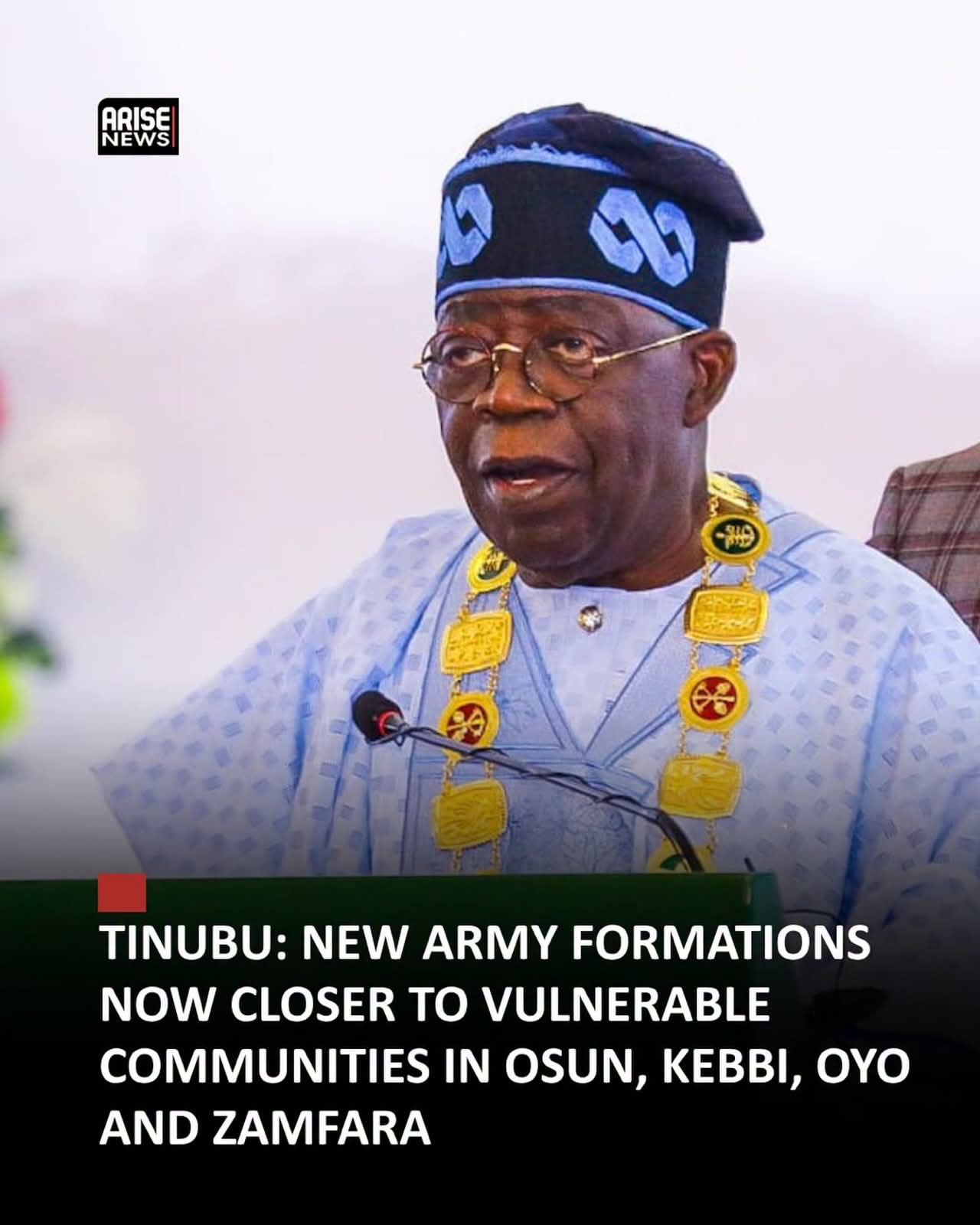
President Bola Ahmed Tinubu has said the Federal Government is taking further steps to strengthen Nigeria’s security response by moving military formations closer to communities considered vulnerable to attacks and other security threats.
The President disclosed that the Nigerian Army has operationalised new formations in Zamfara, Kebbi, Oyo and Osun states, a move he said would improve the military’s ability to respond more quickly when communities come under threat.
According to Tinubu, having troops closer to vulnerable communities is expected to reduce the time required for security personnel to respond to emergencies. The development comes at a time when several parts of the country continue to face different security challenges, including banditry, kidnapping and attacks on rural communities.
The President made the disclosure while highlighting recent measures by his administration aimed at improving both the operational capacity and welfare of members of the Armed Forces.
“This week, the Nigerian Army operationalised new formations in Zamfara, Kebbi, Oyo and Osun,” Tinubu said, stressing that the closer presence of troops would strengthen the country’s ability to respond “swiftly and decisively” whenever Nigerians are threatened.
The four states are particularly significant in the broader security picture. Zamfara and Kebbi have faced persistent threats from armed bandits and criminal groups, while Oyo and Osun have also experienced security concerns that have increased demands for a stronger security presence in parts of the South-West.
Rather than relying entirely on troops travelling long distances from existing formations when an emergency occurs, the establishment of additional formations is designed to give the military a stronger presence within or closer to affected areas.
The Federal Government is also expanding the infrastructure available to military personnel. Tinubu said the construction of new barracks and depots is being fast-tracked in Abuja, Ekiti, Ebonyi and Kogi states, while the facility in Osun State has already been completed.
The projects are expected to provide additional accommodation and logistical support for personnel while strengthening the military infrastructure required for sustained operations.
For soldiers serving in difficult and security-sensitive locations, the availability of functional barracks, depots and other facilities can have a direct impact on how effectively they carry out their duties. The government’s latest announcement therefore places operational readiness alongside the welfare of the personnel expected to carry out those operations.
Tinubu also drew attention to the recent increase in the pay of members of the Armed Forces, saying feedback from servicemen and women indicated that the adjustment was already making a difference in the lives of personnel and their families.
The President said improving the welfare of soldiers should be considered part of the country’s broader security strategy. According to him, the government cannot continue to demand sacrifices from military personnel without also providing adequate support for them and their families.
He further acknowledged that military service affects more than the officers and soldiers who are deployed. Families are also left to deal with the uncertainty and sacrifices that come with having a loved one serving in areas where security threats remain high.
“Every deployment is a sacrifice made by a family too,” Tinubu said, highlighting the often overlooked burden carried by spouses, children and other relatives of military personnel.
The President, who serves as Commander-in-Chief of the Armed Forces, said his responsibility includes ensuring that the military has the resources and support required to carry out its constitutional duties.
The latest announcement also fits into a wider effort by the administration to restructure and strengthen Nigeria’s military response to insecurity. In July, Tinubu said the creation of four additional Nigerian Army divisions was intended to ensure that the military could respond more swiftly to insecurity wherever it occurred.
Earlier in the year, the administration also announced other security measures in response to attacks and abductions, including the deployment of additional security resources and consideration of new military bases in areas facing serious threats.
Beyond expanding military formations, the Federal Government has also been working on a longer-term strategic approach to national security. In August, Tinubu approved the preparation of a comprehensive National Threat Assessment and a five-year Strategic Defence Operations Plan intended to identify major threats, assess capability gaps and establish operational priorities for the Armed Forces.
The latest deployment of formations in Zamfara, Kebbi, Oyo and Osun therefore represents another layer in the government’s security strategy. The objective is not simply to have more military facilities, but to position troops in locations where they can reach communities more quickly when intelligence points to an imminent or ongoing threat.
For residents of communities affected by insecurity, however, the real measure of these investments will ultimately be what happens on the ground. Nigerians want to see faster intervention when attacks occur, better protection for vulnerable communities and stronger intelligence capable of preventing attacks before they happen.
The government’s decision to combine new formations with additional barracks, depots, improved personnel welfare and increased pay suggests an attempt to address both sides of the security equation: giving troops the capacity to operate effectively while improving the conditions under which they serve.
As the security situation continues to evolve across the country, the success of these measures will depend heavily on effective coordination among the military, police, intelligence agencies, state governments and local communities.
For now, Tinubu has reaffirmed that his administration intends to continue providing the Armed Forces with the personnel, infrastructure, resources and welfare support needed to protect Nigerians.
The President’s message is also aimed at the families of military personnel, assuring them that the sacrifices made by their loved ones are recognised and that the government has a responsibility to support those who serve as well as the families waiting for them at home.
With new Army formations now operational in four additional states and military infrastructure projects being accelerated in several others, the Federal Government is betting on a more decentralised security presence to improve Nigeria’s ability to respond to threats before they escalate into wider crises.