Physical Address
304 North Cardinal St.
Dorchester Center, MA 02124
Physical Address
304 North Cardinal St.
Dorchester Center, MA 02124

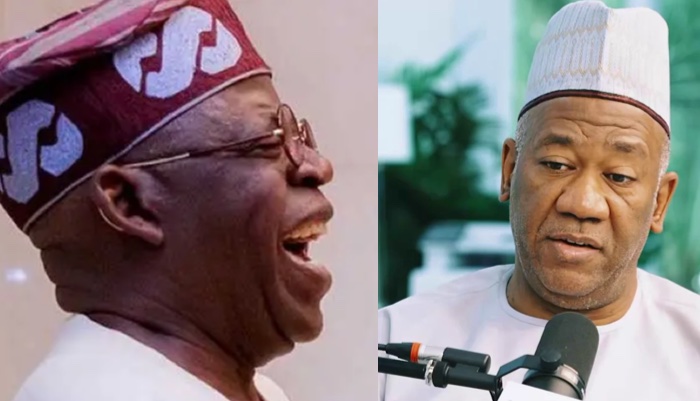
Former Labour Party presidential candidate Peter Obi’s running mate in the 2023 election, Datti Baba-Ahmed, has offered an unexpected assessment of President Bola Ahmed Tinubu’s political strength ahead of the 2027 presidential election, saying the President’s long years of political organisation and alliance-building have given him an advantage that his opponents should not underestimate.
Baba-Ahmed, while discussing the emerging political contest in a television interview, acknowledged that although he disagrees with several of Tinubu’s policies, the President has demonstrated something many Nigerian politicians have struggled to achieve — the ability to build and sustain a political structure over a long period.
According to him, Tinubu did not suddenly become politically influential when he became President. Rather, he spent about 16 years deliberately building political networks, cultivating alliances and positioning himself for national relevance. Baba-Ahmed pointed specifically to Tinubu’s role in the political realignment that eventually produced the victory of former President Muhammadu Buhari and the formation of the All Progressives Congress (APC) as evidence of his strategic political thinking.
“Even though I don’t entirely agree with him, he did what others were not able to do. He organised for 16 years, not just planning,” Baba-Ahmed said.
That statement is coming from someone who was himself deeply involved in the opposition’s 2023 presidential campaign, making the assessment particularly noteworthy. Baba-Ahmed and Obi were the Labour Party’s presidential and vice-presidential candidates in 2023 and emerged as one of the most formidable alternative political combinations outside the two major establishment parties.
But as the 2027 election approaches, Baba-Ahmed appears to be taking a more realistic look at the political machinery surrounding Tinubu.
His argument is simple: elections are not won by popularity alone. They are also won by organisation, alliances, political structures and the ability to keep those structures together until election day.And on that score, he believes Tinubu has demonstrated considerable strength.
Baba-Ahmed recalled the political developments that preceded the 2015 presidential election, when opposition forces came together around Buhari. Tinubu was one of the key figures involved in the political realignment that brought together different opposition interests and helped create the APC. The party subsequently defeated the then-ruling Peoples Democratic Party (PDP), marking the first time an incumbent Nigerian president was defeated at the ballot box since the beginning of the Fourth Republic.
For Baba-Ahmed, that achievement remains an important part of Tinubu’s political record.He described Tinubu’s eventual victory in the 2023 presidential election as an extraordinary political accomplishment, particularly because of the political calculations and unconventional alliances involved in getting there.
The former Labour Party vice-presidential candidate also contrasted Tinubu’s political organisation with the situation confronting some of his major opponents. While several opposition politicians possess strong personal followings, Baba-Ahmed’s assessment suggests that converting individual popularity into a nationwide electoral machine remains a different challenge altogether.
This could become one of the most important issues of the 2027 election.
Nigeria’s opposition landscape has undergone significant changes since 2023. Peter Obi has moved from the Labour Party into the emerging opposition arrangement around the Nigeria Democratic Congress (NDC), while former Vice President Atiku Abubakar and other prominent political figures have also become part of the broader opposition realignment. The African Democratic Congress (ADC) had previously emerged as another major platform for opposition politicians seeking to challenge the APC.
The problem, however, is that opposition popularity does not automatically translate into electoral victory.
Political observers have repeatedly pointed to divisions within the opposition as one of the biggest obstacles to mounting a credible challenge against Tinubu. A recent analysis by The Guardian noted that the opposition’s ability to overcome internal divisions and build a serious alternative could be more decisive than public dissatisfaction with economic hardship and insecurity.
That is precisely where Tinubu’s political structure becomes important.
Whatever criticisms may be levelled against the President’s administration, his political journey has given him decades of experience in party organisation, coalition-building and electoral strategy. From Lagos politics to the national stage, Tinubu has spent years cultivating relationships with politicians across different parts of the country.
Baba-Ahmed’s comments therefore appear to recognise a reality that political opponents cannot simply wish away: Tinubu has spent considerably more time building political networks than many of the politicians now attempting to defeat him.
However, acknowledging Tinubu’s political strength is not the same thing as endorsing his administration.
Baba-Ahmed made it clear that he does not agree with many of the President’s policies. His comments were therefore more about political organisation and strategy than an endorsement of Tinubu’s performance in government.
And that distinction matters.
A strong political machine can help a candidate win elections, but winning an election and governing successfully are two different things. Nigerians will ultimately judge the 2027 contenders not only by their political structures but also by their records, policies, credibility, economic plans, security strategies and ability to convince voters that they can improve the country.
For Tinubu, the challenge is therefore to convert his political organisation into broader public support. The opposition, meanwhile, faces the equally difficult task of turning its various personalities, movements and voter blocs into one coherent national force.
That battle is already taking shape.
Peter Obi retains a strong support base, particularly among young Nigerians and voters who view him as an alternative to the traditional political establishment. Atiku Abubakar has decades of political experience and a nationwide network. Other opposition figures also bring their own regional influence and political structures to the table.
Yet, as Baba-Ahmed’s comments suggest, the question is not merely who has supporters. The bigger question is who has the organisation to mobilise those supporters effectively across Nigeria’s complicated electoral landscape.
Interestingly, Baba-Ahmed has also previously made strong comments about the 2027 contest, including the assessment that only God could stop Tinubu from winning the election. He has simultaneously argued that none of the major opposition contenders currently has the capacity to move Nigeria forward, making his latest comments part of a broader and increasingly outspoken assessment of the political landscape.
The 2027 presidential race is still some distance away, and political calculations can change dramatically before Nigerians go to the polls. Alliances can collapse, new coalitions can emerge, candidates can change platforms and voters can shift their preferences.
But one lesson from Nigerian politics remains difficult to ignore: structure matters.
Tinubu’s political organisation did not emerge overnight, and Baba-Ahmed’s acknowledgement of the President’s 16-year political build-up is a reminder that electoral victories are often the product of years of preparation rather than a few months of campaigning.
Whether that organisation will ultimately be enough to secure another presidential victory in 2027 remains a question for Nigerian voters. But for now, even one of Tinubu’s former political opponents is acknowledging that the President’s greatest strength may not simply be his current position in Aso Rock — it is the political machinery he spent years building before he ever got there.