Physical Address
304 North Cardinal St.
Dorchester Center, MA 02124
Physical Address
304 North Cardinal St.
Dorchester Center, MA 02124

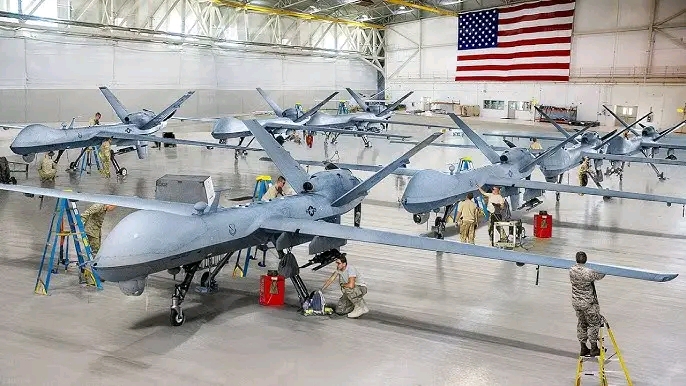
AMERICA SENDS DRONES AND SOLDIERS TO NIGERIA: WHAT THIS MEANS FOR THE WAR AGAINST BOKO HARAM AND ISWAP. For the first time in years, the United States has made a significant and visible military move into Nigeria’s insurgency theatre. According to reports, Washington has deployed approximately 200 troops and MQ-9 Reaper drones to Nigeria, with the stated mission of providing intelligence support and training assistance to Nigerian security forces battling jihadist groups in the North East. is not a small development. This is a statement.
THE DEPLOYMENT: WHAT WE KNOW. The MQ-9 Reaper is not a toy. It is one of the most sophisticated unmanned aerial vehicles in the American military arsenal — capable of long-endurance surveillance, real-time intelligence gathering, and precision strike operations. Its deployment to Nigeria signals that Washington is taking the Lake Chad Basin insurgency seriously enough to commit serious hardware.The 200 troops accompanying the drones are understood to be special operations personnel and training advisers, not combat soldiers in the conventional sense. Their role, at least officially, is to enhance the capacity of Nigerian forces rather than to engage insurgents directly. But anyone familiar with how American military partnerships operate knows that the line between “training support” and active operational involvement can blur quickly on the ground.
THE CONTEXT: WHY NOW? Nigeria’s North East has been bleeding for over fifteen years. Boko Haram, and its more dangerous offshoot, the Islamic State West Africa Province — ISWAP — have killed tens of thousands of civilians, displaced millions, and consistently embarrassed a military that has struggled to achieve a decisive victory despite repeated government declarations of imminent success.In recent months, attacks have intensified. Borno State has remained a killing field. Soldiers have been ambushed, civilians massacred, and entire communities abandoned to the mercy of terrorists. The Nigerian military has fought hard, but the intelligence gap has always been a critical weakness. You cannot defeat an enemy you cannot find, track, or predict. That is precisely where American drones come in.
The MQ-9 can loiter over vast stretches of ungoverned terrain for hours, feeding real-time imagery and signals intelligence to commanders on the ground. If properly integrated into Nigeria’s operational command structure, this capability alone could transform how the military tracks ISWAP movements, locates camps, and anticipates attacks.
THE SOVEREIGNTY QUESTION. Not everyone will welcome this deployment with open arms, and rightly so.Nigeria is a sovereign nation. The presence of foreign troops on Nigerian soil — however limited in number and however benign in stated purpose — raises legitimate questions that must be asked openly. What are the terms of this deployment? What agreements govern the conduct of these troops? Who authorized it, and was the National Assembly informed? What are the exit conditions? And critically, what does the United States get in return?History teaches that American military partnerships in Africa rarely come without strings. From the Sahel to the Horn of Africa, Washington’s counterterrorism engagements have had mixed records, and in some cases, left fragile states more unstable than before. Nigeria must ensure that this is a partnership of equals, not a quiet handover of strategic decision-making to a foreign power.
WHAT TINUBU’S GOVERNMENT MUST DO.
The Tinubu administration owes Nigerians full transparency on this deployment. The details of any agreement signed with Washington must be disclosed to the legislature and to the public. Nigerians are not spectators in their own country’s security arrangements.Beyond transparency, the government must ensure that this American support is actually being used to its maximum potential. Too often in Nigeria, foreign training and intelligence assets are wasted by a command structure riddled with leaks, corruption, and poor coordination. The real danger is not that the Americans will overstep — it is that Nigerian institutions will fail to take advantage of what is being offered.
THE BIGGER PICTURE. This deployment is also a signal of where Nigeria sits in American strategic calculations right now. With the United States recalibrating its global military posture and watching the spread of jihadist networks across West Africa with growing alarm, Nigeria — the most populous country on the continent and a major oil producer — is too important to leave to chance. From Washington’s perspective, a Nigeria destabilized by ISWAP is a threat that extends far beyond Borno State. It threatens regional stability, global energy markets, and the broader contest against extremist ideology in sub-Saharan Africa.
For ordinary Nigerians in the North East — the farmers, traders, mothers, and children who have lived under the shadow of terrorist violence for a decade and a half — none of this geopolitical calculus matters as much as one simple question: will this finally bring peace?The drones are in the sky. The soldiers are on the ground. Now let us see if the results follow.