Physical Address
304 North Cardinal St.
Dorchester Center, MA 02124
Physical Address
304 North Cardinal St.
Dorchester Center, MA 02124

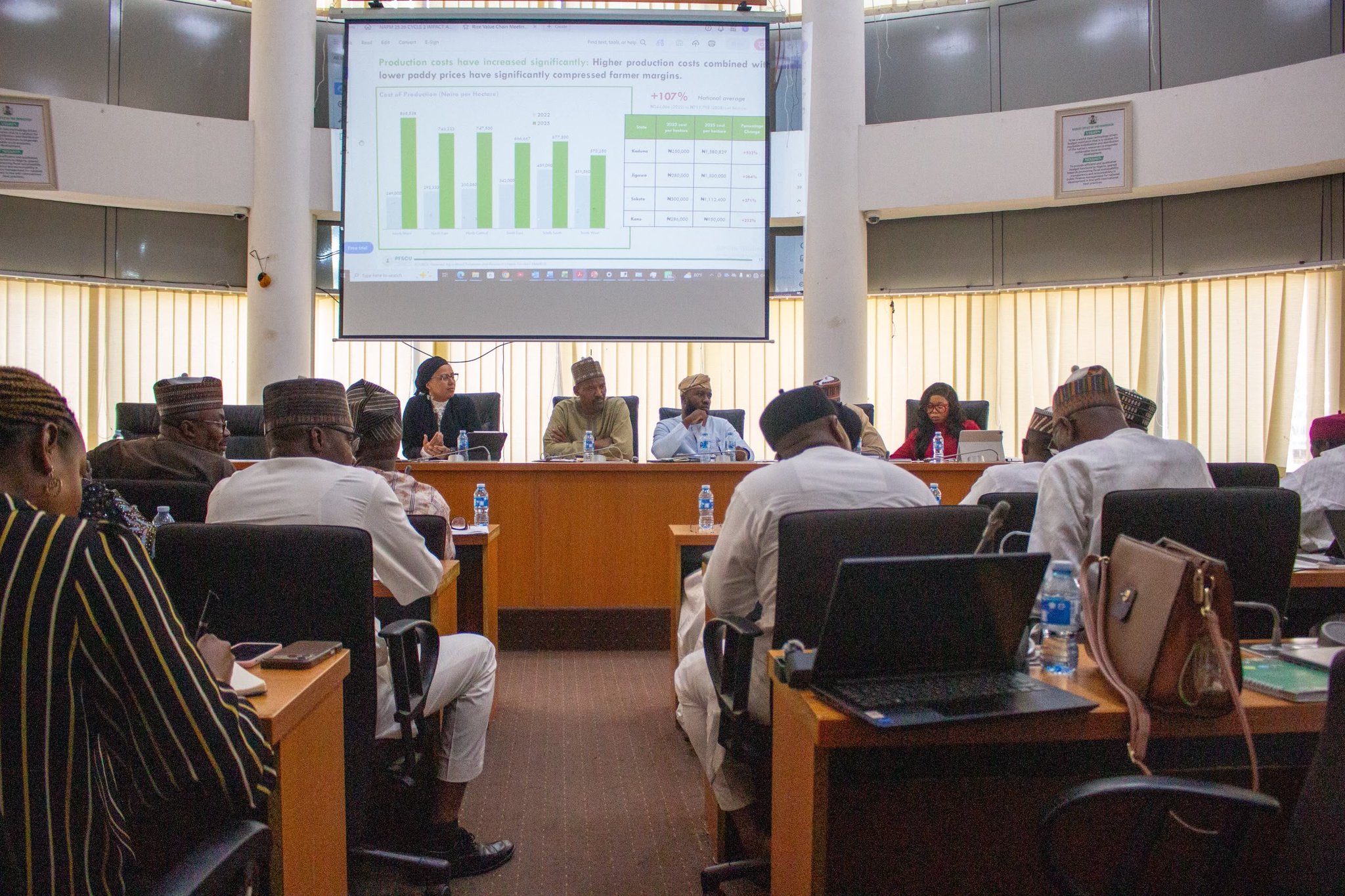
The Federal Government has stepped up efforts to tackle some of the long-standing problems confronting Nigeria’s rice industry, bringing key stakeholders together to examine the rising cost of production, access to finance, irrigation, storage facilities and difficulties affecting the movement and marketing of rice across the country.
The latest engagement reflects the government’s broader push to strengthen domestic agriculture and reduce the pressures that have continued to affect food production and prices. Rice remains one of Nigeria’s most important staple foods, with millions of households depending on it while farmers, millers, transporters, traders and other businesses rely on the crop for their livelihoods. As a result, challenges in one part of the value chain can quickly affect the price paid by consumers at the market.
At the centre of the discussion is the cost of producing rice. Farmers have continued to contend with the high prices of inputs, machinery, labour, transportation and other essentials required to cultivate and process the crop. When production costs rise, the pressure is eventually transferred down the chain, affecting millers, wholesalers, retailers and, ultimately, consumers.
The Federal Government has previously acknowledged the need to address the cost of agricultural inputs and improve financing for farmers. In February 2026, the Ministry of Agriculture and Food Security, alongside the Bank of Agriculture and other stakeholders, reviewed the National Agricultural Growth Scheme and Agro-Pocket programme, with discussions focusing on improving implementation and addressing bottlenecks affecting staple-food production. The government said the programme would support crops including rice, maize and cassava.
Financing is another major concern. Rice farming requires significant investment before farmers can eventually recover their money at harvest. Access to affordable credit therefore remains important, particularly for smallholder farmers who may struggle to obtain conventional bank loans. Nigeria’s National Rice Development Strategy II also identifies improved access to credit as a key requirement for strengthening the rice value chain and achieving greater self-sufficiency.
The Federal Government has also placed greater emphasis on irrigation as part of its agricultural strategy. Dependence on rainfall can limit production to particular periods of the year, while reliable irrigation can allow farmers to cultivate beyond the traditional farming season. The government’s 2026 budget specifically highlights irrigation, climate-resilient agriculture, storage and processing as areas requiring investment to improve food security and reduce post-harvest losses.
Storage is equally important because producing more rice does not automatically solve the problem if farmers cannot properly preserve their harvest. Poor storage can lead to losses, force farmers to sell immediately after harvest when prices may be unfavourable, and create unnecessary shortages later in the year. Nigeria’s National Rice Development Strategy II similarly identifies investment in irrigation, storage and transportation infrastructure as necessary to reduce losses and improve farmers’ access to markets.
Trade is another sensitive part of the conversation. Local rice producers and processors have consistently raised concerns about competition from imported rice and smuggling. In March 2026, the Federal Government held discussions with the Rice Processors Association of Nigeria and said stronger cooperation between government, industry operators and private-sector stakeholders was necessary to strengthen domestic production. Stakeholders at that meeting also called for stronger border enforcement against illegal rice imports.
The government’s latest stakeholder engagement therefore comes at a time when policymakers are attempting to look at the rice sector as a complete chain rather than treating production, processing, financing and marketing as separate problems. The objective is to ensure that interventions reach farmers at the beginning of the chain while also improving the conditions under which rice is processed, transported, stored and sold.
This approach is consistent with the Federal Government’s broader agrifood strategy. In July 2026, Agriculture Minister Abubakar Kyari said the government was developing a 10-year Agrifood System Strategy and Action Plan designed to improve coordination across Nigeria’s agricultural ecosystem. The framework brings together government institutions, farmers’ organisations, development partners, academia and private-sector players.
There is also a growing recognition that government cannot solve the challenges of the rice industry alone. Farmers need access to land, inputs, machinery and finance; processors need reliable supplies of quality paddy and suitable infrastructure; traders need functioning markets and transport networks; while consumers need affordable and reasonably stable prices.
For many Nigerians, the real test will not be how many meetings are held or how many policy documents are produced, but whether the interventions eventually translate into cheaper production, higher yields, fewer post-harvest losses and more predictable prices in the market.
Nigeria already has considerable agricultural potential, but unlocking that potential requires consistency. Stakeholders in the rice value chain will therefore be watching closely to see whether the latest discussions produce practical measures that can be implemented at farm and market levels.
If the government succeeds in addressing financing, irrigation, storage, production costs and trade bottlenecks together, the impact could extend beyond rice farmers. A stronger rice value chain could support rural employment, expand agro-processing, improve food security and strengthen businesses operating across the agricultural economy.
The challenge now is implementation. The Federal Government has repeatedly outlined plans to strengthen agriculture and food production, but the success of those plans will ultimately depend on whether policies are properly funded, coordinated and sustained, while farmers and private-sector operators are given the conditions needed to invest and expand.